

One of the most common questions business owners ask when planning a new website is: should I use WordPress or have a custom website built? It seems like a simple question, but the right answer depends on your specific goals, budget, technical needs, and long-term plans.
Both options have genuine strengths. Neither is universally better. This guide gives you a clear, honest comparison so you can make the right choice for your business in 2026.
What is a WordPress Website?
WordPress is an open-source Content Management System (CMS) that powers approximately 43% of all websites on the internet. It provides a foundation — database, admin panel, templating system — that developers build on top of using themes and plugins.
A WordPress website can range from a simple 5-page business site built with a theme and page builder, to a fully custom-designed and developed platform with no off-the-shelf code. The key distinction is that WordPress is the engine underneath.
What is a Custom Website?
A custom website is one built from scratch using modern development frameworks — React, Next.js, Vue.js, Astro, or a purpose-built backend with Node.js, Python, or PHP — without using a pre-existing CMS foundation.
Custom development gives your development team complete control over every aspect of the website: architecture, design, performance, and functionality. Nothing is inherited from a pre-built system.
Cost Comparison
WordPress
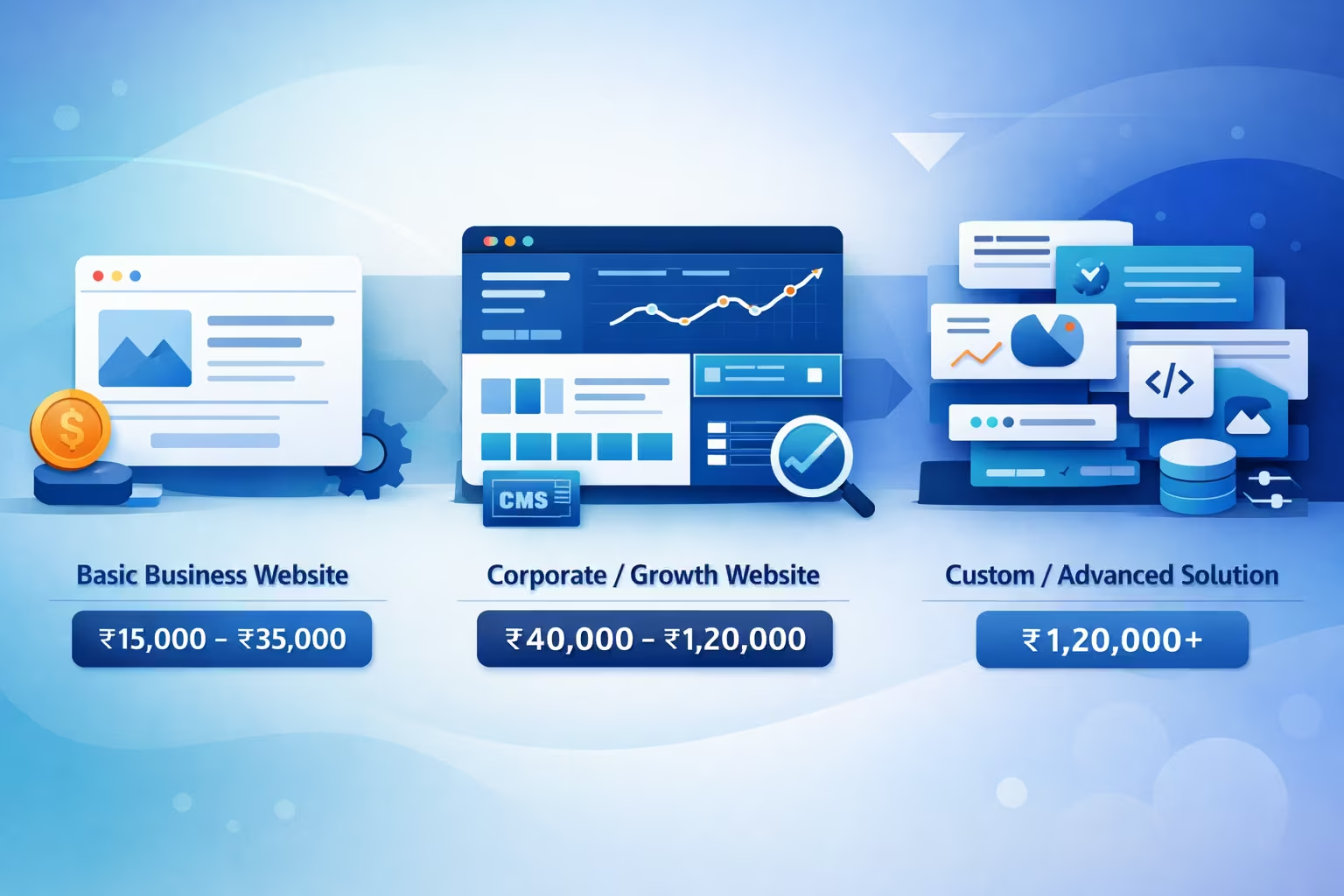
A basic WordPress website can be built by a competent developer for ₹15,000–₹50,000 using themes and page builders. A professionally designed and developed WordPress website with a custom theme and proper SEO setup typically costs ₹40,000–₹1,20,000.
The lower floor makes WordPress attractive for businesses with tight budgets or straightforward requirements.
Custom Development
Custom development has a higher floor. A professionally built custom website using React/Next.js or a similar modern stack typically starts at ₹80,000–₹1,50,000 for a business website, and ₹2,00,000+ for a web application with backend functionality.
The higher upfront cost reflects the additional engineering hours required when you are not building on an existing foundation.
Verdict: WordPress wins on initial cost for standard business websites. Custom is justified when the project requirements exceed what WordPress can deliver effectively.
Flexibility and Scalability
WordPress
WordPress handles the vast majority of business website use cases well — brochure sites, blogs, eCommerce (via WooCommerce), booking systems, membership sites, and simple portals. The plugin ecosystem (60,000+ plugins) means most common functionality can be added quickly.
However, WordPress has limits. Complex custom logic, high-performance applications, and highly specific multi-user workflows can be awkward to implement in WordPress without significant plugin conflicts and maintenance overhead.
Custom Development
Custom development has essentially no upper limit on what can be built. Complex eCommerce platforms, SaaS applications, multi-tenant portals, AI-powered tools, and high-throughput APIs are all within reach.
If you anticipate significant scale — tens of thousands of users, complex integrations, or a unique product — custom development is the appropriate choice.
Verdict: WordPress suits most standard business websites. Custom development is the right choice for complex applications, unique functionality, and significant scale.
Performance and Speed
WordPress
WordPress can be fast — but it requires deliberate effort. Default WordPress installations with multiple plugins tend to be bloated. Achieving excellent Core Web Vitals scores requires caching plugins, image optimization, code minification, and a quality hosting environment.
Managed WordPress hosting (Kinsta, WP Engine, Pressable) makes good performance easier but adds cost. Even with optimization, a complex WordPress site will generally not outperform a well-built custom site.
Custom Development
A custom-built website, especially one using a modern JavaScript framework or static site generator like Next.js or Astro, can be engineered for exceptional performance from the ground up. Without plugin overhead or CMS database queries on every page load, custom sites routinely score 95+ on Google Lighthouse.
Performance matters — Google’s Core Web Vitals are a confirmed ranking factor, and fast websites convert better.
Verdict: Custom development wins on raw performance potential. A well-optimized WordPress site can be competitive for most use cases, but custom has the edge for performance-critical projects.
SEO Capabilities
WordPress
WordPress is well-suited for SEO. The Yoast SEO and Rank Math plugins provide comprehensive on-page SEO management, schema markup, XML sitemaps, and more. WordPress’s blog capabilities make content marketing straightforward.
For the majority of businesses, WordPress’s SEO capabilities are entirely sufficient.
Custom Development
A custom website gives complete control over SEO implementation — meta tags, structured data, canonical URLs, performance optimization, and everything else. When done well, a custom site can have a technical SEO advantage.
The limitation is that without a built-in CMS, content management for a blog or news section requires either building a CMS or integrating a headless CMS (like Contentful or Sanity).
Verdict: Broadly equivalent for most businesses. Custom has the technical ceiling advantage; WordPress wins on ease of ongoing content SEO management.
Security
WordPress
WordPress’s popularity makes it a major target for hackers. A significant proportion of WordPress hacks occur through outdated plugins, nulled (pirated) themes, and weak passwords. A well-maintained WordPress installation with reputable plugins, regular updates, and a security plugin (Wordfence, Sucuri) is reasonably secure.
However, the ongoing maintenance burden is real. WordPress and its plugins require regular updates, and a single missed update can create a vulnerability.
Custom Development
A custom website’s attack surface is smaller by default — there are no third-party plugins to exploit. Security vulnerabilities are limited to what your development team introduced in the code.
The risk is that a poorly written custom codebase can have serious vulnerabilities that no plugin would have introduced. Security depends entirely on the quality of the development team.
Verdict: A professionally maintained WordPress site and a professionally built custom site both offer strong security. WordPress requires more ongoing maintenance vigilance.
Maintenance and Long-Term Costs
WordPress
WordPress requires regular maintenance: core updates, plugin updates, theme updates, database optimization, and security monitoring. Monthly maintenance costs for a WordPress site typically run ₹2,500–₹6,000 per month for a professional maintenance plan.
Custom Development
Custom sites typically require fewer routine updates (no plugin ecosystem to maintain) but are more expensive to modify when changes are needed — because changes require a developer with knowledge of the specific codebase. Monthly maintenance is lower for a stable custom site but higher for actively evolving applications.
Verdict: WordPress has higher routine maintenance costs; custom has lower routine maintenance but higher feature development costs.
When to Choose WordPress
Choose WordPress when:
- You need a business website, blog, portfolio, or eCommerce store
- Your budget is ₹20,000–₹80,000
- You want to manage content yourself without developer involvement
- Your functionality requirements are standard (contact forms, blog, gallery, WooCommerce store)
- You need to launch quickly
- You want a large ecosystem of themes, plugins, and developer knowledge
When to Choose Custom Development
Choose custom development when:
- Your application requires complex, unique logic that plugins cannot handle
- Performance is critical (sub-1-second load times, high Lighthouse scores)
- You are building a SaaS product, multi-tenant platform, or complex portal
- You require deep API integrations with enterprise systems
- Your budget is ₹1,50,000+
- Long-term scalability and maintainability are top priorities
The Hybrid Approach: Headless WordPress
A growing middle ground is headless WordPress — using WordPress as a backend CMS while delivering content through a modern frontend framework like Next.js or Astro. This gives you WordPress’s content management ease with custom development’s performance and flexibility advantages.
This approach is increasingly popular for content-heavy sites and eCommerce at scale. It requires a more sophisticated development team and a higher budget, but it is often the best of both worlds for businesses that have outgrown standard WordPress but don’t want to abandon its content management tools.
Final Recommendation
For the majority of small and medium businesses — a local service provider, a clinic, a school, a retailer, a professional firm — WordPress is the right choice. It delivers a professional, maintainable website at accessible cost.
For businesses building complex applications, unique digital products, or performance-critical platforms, custom development delivers the control and scalability that WordPress cannot.
At eLan Technology, we build both — and we recommend the right approach based on your specific goals, not what is easiest for us to deliver. Contact us for a consultation and we will give you an honest recommendation.